Online Gaming among young adults during COVID-19 Lockdown in India – Implications for Social Work Practice
J. S. Gunavathy, Associate Professor, Dept of Social Work (Aided Stream), Madras School of Social Work
R. Shama Shareen, MSW Student of 2020-22 Batch, Madras School of Social Work
N. T. Bhanu Priya, MSW Student of 2020-22 Batch, Madras School of Social Work
S. Harisha, MSW Student of 2020-22 Batch, Madras School of Social Work
L. Jenita Evangeline, MSW Student of 2020-22 Batch, Madras School of Social Work
E. M. Prem Jonathan, MSW Student of 2020-22 Batch, Madras School of Social Work
J. Priyadarshini, MSW Student of 2020-22 Batch, Madras School of Social Work
Abstract: As COVID-19 threw life out of gear, there were a wide range of human responses to find respite from the chaos and uncertainty. One predominant pursuit that witnessed a surge during COVID-19 lockdown was online gaming. This study set in the Indian context sought (a) to understand the online gaming practices and experiences of young adults during COVID-19 lockdown in India, (b) to assess the extent of online gaming disorder, (c) to test the significance of socio-demographic factors on internet gaming disorder, and (d) to identify the implications for social work practice. Data were collected through an online survey among Indian youth aged between 15 years and 29 years who engaged in online gaming (n=501) during the COVID-19 lockdown. Findings revealed that respondents played for more than five hours per day, preferred battle arena games and used mobile phones for the gaming experience. Instances of gaming disorder have also been identified. The beneficial and detrimental aspects of online gaming provide ample scope for application in social work practice. This paper presents the implications for social work practice in this context and puts forth suggestions.
Keywords: Online gaming; youth; India; COVID-19 Lockdown; Internet Gaming Disorder
1 Introduction and Problem Statement
World over, as the COVID-19 lockdown confined people to their homes, many took to new activities including online gaming. During COVID-19 lockdown, online gaming became a favorite activity for many to spend their leisure time (Javed, 2020) with an increase in online gaming activity among college going students (Balhara et al., 2020), among individuals aged between 25 and 35 years and with a slight increase in female users (Bora, 2020) thanks to its engaging nature and easy availability of smart phones and internet connection. Reports indicate that China, India and the US constitute the largest market for the gaming industry. In terms of number of gamers, China ranks number one with 1.5 billion gamers followed by India with 560 million gamers (ECI games, 2025).
In India, online gaming picked up momentum since the COVID-19 lockdown as evidenced by the booming digital media market and the growth in the online gaming industry revenue, users and usage. The 21.1 billion US dollars (USD) revenue of the global digital media market in 2020 is attributed to the global COVID-19 outbreak when people stayed at home and turned to digital avenues for entertainment and for connecting with others (Statista, 2021). The online gaming industry grew at a Compounded Annual Growth Rate (CAGR) of 21% during the lockdown, with 7.3 billion mobile game installs in the first three quarters of 2020 (The Hindu dated 14th June, 2021). According to Gameconomy Report 2023, between financial years 2020 and 2023, the industry grew at 28% CAGR with a market size of over USD 185 million and is projected to double by financial year 2028 (Kalaari Capital, 2023). The time spent on gaming in India is on the increase with average time spent on gaming per person per week raising from 9-11 hours in 2022 to 10-12 hours in 2023 (Lumikai Investment Advisors Report, 2023). The BBC (2020) report entitled ‘How online gaming has become a social lifeline’ states that online gaming has skyrocketed during the pandemic, engaging occasional players and also first-time entrants.
Barr and Copeland-Stewart (2021) studied the online game play habits and effects on players’ well-being (n=781) with majority (82.9%) of the respondents aged 16 to 34 years. There was a multiple fold increase in the percentage of respondents who had played online games several times a day, rising from 10.5% before the pandemic to 40% during the lockdown for reasons like coping, socializing and time pass. The mental health benefits of online gaming were distraction from the anxiety associated with pandemic, stress relief, diversion, cognitive stimulation, sense of normalcy and socialisation. The negative aspects of online gaming were being less productive and waste of time. Thus the positive aspects of online gaming seemed to outweigh the negative aspects.
Dekker and Slotboom (2023) based on their systematic literature review have summarised the benefits and ill effects of recreational gaming. The four-fold benefits of online gaming have been classified as cognitive, vision, emotional and social. Cognitive benefits include reflective problem solving, sustained attention, creative thinking, incremental intelligence, attention allocation and spatial thinking. The vision related benefits are spatial resolution, contrast sensibility and selective visual attention. Emotional benefits include happiness, self-esteem, pride, sense of control, relaxation and adaptive regulation. Social benefits are civic behaviour and social competence. No somatic benefit is reported. The cognitive ill effects are insomnia and anxiety. Interestingly, no vision and emotion related ill effects are reported. The social dysfunction (manifested as isolation and neglecting others and tasks) is listed as the social ill effect of gaming. Somatic ill effect is attributed to musculoskeletal complications. They call for moderation in gaming.
As online gaming is habit forming, internet gaming disorder has been added in the “International Classification of Diseases” (World Health Organization, 2018) and in the “Diagnostic and Statistical Manual of Mental Disorders - 5” (American Psychiatric Association, 2018). Gaming disorder is the only non-substance abuse present in DSM-5 with symptoms like (a) not being able to stop playing games, (b) thinking about games when being not able to play, (c) continuing to play games even after facing problems, (d) loss of interest in other activities and (e) risk of losing job or relationship due to excessive gaming.
Mishra, Singh and Singh (2020) found that online gaming addiction among youth as a behavioural addiction had psychological health implications. Gamers who spent much time on online gaming, confined themselves at home and often perceived online gaming as a way of emotional escape from the real world. Increased online gaming screen time resulted in increased anxiety and depression. Youth who spent hours playing online games compromised attention to the basic needs of their body such as bathing or eating resulting in impaired social functioning. They also found that gamers avoided interacting with family and preferred to rely on the virtual world more. Gamers were found to attain satisfaction by playing online games than by achieving in academics or at their workplace. Young parents who were involved much in online games tended to neglect their children and did not spend time with them.
Archana, Sharma, Kumar and Marimuthu (2019) in their study on Internet gaming disorder among gamers in Bangalore, India found that over half of the online game addicts displayed psychological distress. Fatigue, low self-esteem and loneliness were prevalent in people who had internet gaming disorder. Having a supportive family and emotional stability helped reduce the chances of internet gaming addiction. Their study highlighted the need for intervention programs to handle internet gaming disorder and other psychological problems.
Online gaming is on the rise and has come to stay. While online gaming is presented as entertainment there is so much more to it than what meets the eye. Despite its benefits, its detrimental effects are imminent. Nevertheless, public recognition of the same as an issue to be reckoned with is limited (Naskar, et al., 2016). Many people who start playing online games to spend their leisure time could end up getting addicted to those games with mental and physical health ramifications. Negative experiences like cyber bullying and harassment could lead to anxiety and depression. In India, instances of fatalities due to online gaming related losses have been reported in the dailies (Hindustan Times, 17 February 2022; The Times of India, 28 March 2021). Thus, given the implications of online gaming and its effect on the fabric of society and the volume of online gamers, it is important to study about online gaming in the Indian context. The present study is an effort in this direction.
The objectives of the study set in the Indian context are (a) to understand the online gaming practices and experiences of young adults during COVID-19 lockdown in India, (b) to assess the extent of online gaming disorder, (c) to test the significance of socio-demographic factors on internet gaming disorder, and (d) to identify the implications for social work practice.
This paper presents the findings of a study carried out among Indian Youth who played online games during COVID-19 lockdown and seeks to understand the patterns of online gaming and also the extent of internet gaming disorder. The study also spells out the implications for social work practice.
2 Methods
2.1 Study overview
The study was conducted among youth in India. The study was carried out as part of the project field work component of the Master of Social Work post-graduate degree curriculum. The study was self-funded.
This study adopted descriptive research design. The source of data was primary. The unit of analysis was youth (individuals) playing online games. The study focused on online gaming and not any form of online gambling. The term ‘online games’ has been operationally defined to refer to games procured or accessed through online channels and those that require internet in the primary game-play experience (KPMG, 2017). In India, as per the National Youth Policy 2014, the term ‘youth’ covers persons aged between 15 and 29 years (Government of India, 2022).
2.2 Sample
The universe of the study is youth in India aged from 15 to 29 years, playing any type of online games. The sampling technique was purposive. The inclusion criteria were (a) the respondent should be in the age group of 15 to 29 years, (b) the respondent should be playing any type of online games, and (c) the respondent should be recreational gamers. The exclusion criteria were that (a) individuals who were professional gamers and (b) individuals who engaged in games that had elements of gambling were not considered for the study.
2.3 Procedure
The tool used for data collection was a questionnaire that was administered in the online mode. The online questionnaire had an outline of the study that served to inform the participants about the purpose and scope of the study. The tool had 38 questions under five sections namely, Demographic details, Gaming pattern, Resources, Emotional response and other effects and Gaming Disorder.
Section 1 on ‘Demographic details’ had questions on age, educational qualification, area of residence, gender, employment status and income. Section 2 on ‘Online Gaming Experiences’ had eight questions to understand the gaming pattern of the players. It included questions on number of years of gaming, factors introducing them to online gaming, number of games played concurrently, their favourite type of games, their favourite features in the games, the device used for gaming and whether the lockdown had increased their gaming activity or not. Each of these questions had relevant options for the respondents to select. Section 3 on ‘Resources’ had six questions to map the time and resources spent by the respondents on gaming activity. The questions covered the number of hours spent in gaming, the amount of money spent, whether they had won any money or suffered any financial problems and whether they had bought any device to enhance the gaming experience. Section 4 on ‘Emotional response and other effects’ helped to comprehend the emotions one underwent after gaming and the effect of gaming on their health and social life. The last section sought to measure Internet Gaming Disorder. Gaming Disorder was measured using the 9-item Pontes and Griffiths (2015) Internet Gaming Disorder Scale that helps assess the severity of internet gaming disorder. The response pattern is a 5-point Likert scale ranging from 1 (“Never”) to 5 (“Very Often”). The scale is uni-dimensional and higher scores indicate higher degrees of internet gaming disorder. A score of 32 or above meant that the person is diagnosed with the disorder. The Cronbach alpha value was 0.85.
The tool was subjected to expert validation and was pre-tested on five individuals fulfilling the inclusion criteria. The online data collection was done using google forms circulated through social media platforms during November, 2020. Online mode of data collection was preferred owing to public health restrictions in the COVID context. There were 501 valid responses in total. The respondents voluntarily participated in the survey. The ethical principles of consent, voluntary participation, anonymity and confidentiality were complied with.
2.4 Data Analysis and Interpretation
Data analysis was done using SPSS software version 20. Data have been presented as tables and diagrams. Descriptive and inferential statistics have been applied.
2.5 Limitations of the Study
The study suffers from the limitations of online data collection. Also, as the data is mostly from the home city, generalisability of the findings will be applicable to only similar milieu. Further, on account of the inclusion criteria, data pertains to those aged between 15 and 29 years and hence results will not apply to online gaming practices and disorder among other age groups. Besides, the present study findings may not apply to competitive online game players. The present study adopts a quantitative approach and hence insights about meanings and personal experiences are not available.
3 Results
3.1 Demographic Profile
Most of the respondents (46.9%) were from the age group of 15-17 years followed by those in the age group of 18-20 years (37.9%). The respondents ranged from those in high school to those who have completed post-graduation. Most of the respondents were graduates (58.3%) followed by post-graduates (26.3%). Male respondents were more in the sample (57.7%). Majority of respondents (75.8%) were unemployed as they were from the student community. Majority of the respondents were from the home city (Chennai, Tamil Nadu).
3.2 Online Gaming Pattern
A little more than two-fifth of the respondents (40.9%) had stated that they were into online gaming for more than three years.
The predominant source of introduction to online gaming was family and friends (46.5%) followed by self-interest (36.03%) and social media (17.47%). Great majority of the respondents (80.4%) reported that they actively played upto two games while less than one-tenth of the respondents played more than four games.
Online games are classified as Massively Multiplayer Online Games, Online Casino Games and Sports Games (Davies, 2020) and can be played across single-player, multiplayer and massively multiplayer formats. Almost half of the respondents (45.77%) preferred battle arena games (also known as Multiplayer Online Battle Arena games) while a little more than one-fourth of the respondents (29.66%) preferred role-playing games. Fantasy sport was preferred by 20.73 percent of the respondents and the rest opted for arcade games.
As regards the most appealing feature of these online games, 48.04 percent of the respondents preferred the socialisation feature while 37.57 percent of the respondents preferred the graphics and aesthetics. Less than one-fifth of the respondents (13.55 percent) considered the reward and punishment element to be appealing.
Respondents were required to reflect on the pull factors associated with online gaming. Results showed that majority of the respondents (60.8%) were influenced by peer influence while almost one-third of the respondents (32.4%) were influenced by rewards. The other factors included entertainment and relaxation.
Majority of the respondents (72.44%) stated that they used mobile phones for online gaming while a little more than one-fifth of the respondents (21.31%) used laptops and Personal Computers for online gaming and less than ten percent (6.25%) of the respondents used Xbox/PlayStation for online gaming.
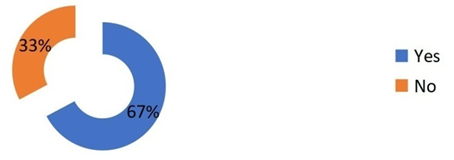
A little more than two-third of the respondents (67.3%) felt that their gaming activity had increased due to COVID-19 lockdown. The same has been diagrammatically represented (refer Diagram 1).
Diagram 1: Increase of Gaming Activity during COVID-19 Lockdown
3.3 Resources Committed
Table 1: Respondents by Resources Spent on Online Gaming
|
S.No |
Hours Spent on Online Gaming per Day |
Frequency (n) |
Percentage (%) |
|
1. |
Less than 3 hours |
372 |
74.3 |
|
2. |
3 to 5 hours |
90 |
18 |
|
3. |
More than 5 hours |
39 |
7.8 |
|
|
Total |
501 |
100 |
|
S.No |
Nature of Apps Used for Online Gaming |
Frequency (n) |
Percentage (%) |
|
1. |
Paid apps, done in-app purchases |
39 |
6.98 |
|
2. |
Paid apps, have not done in-app purchases |
19 |
3.40 |
|
3. |
Free apps, done in-app purchases |
119 |
21.32 |
|
4. |
Free apps, not spent money in-app |
381 |
68.27 |
|
|
Total |
558* |
100 |
|
S.No |
Amount spent per month per Gaming Season (in Indian Rupees) |
Frequency (n) |
Percentage (%) |
|
1. |
Less than Rs.500 |
66 |
13.2 |
|
2. |
Rs.500-Rs.2000 |
38 |
7.6 |
|
3. |
Above Rs.2000 |
21 |
4.2 |
|
4. |
No Money Spent |
376 |
75 |
|
|
Total |
501 |
100 |
|
S.No |
Purchase of device to maximise Gaming Experience |
Frequency (n) |
Percentage (%) |
|
1. |
Yes |
108 |
21.6 |
|
2. |
No |
393 |
78.4 |
|
|
Total |
501 |
100 |
*Multiple Responses
The respondents were required to reflect on the resources committed for their online gaming in terms of time, technology and money. From Table 1 it is evident that most of the respondents (74.3%) have reported that they spent less than three hours per day on online gaming. Attention needs to be paid to the fact that 7.8 percent of the respondents have stated that they spent more than five hours on online gaming every day.
Majority of the respondents (89.59%) used free apps for online gaming. However, almost one-third of the respondents who used free apps (31.23%) and more than two-third of the respondents who used paid apps (67.24%) had opted for in-app purchases. Similarly, 6.98 percent of the respondents have stated that they used paid apps and have done in-app purchases. As regards money spent to access certain features of the game (for instance, to unlock characters or to go to the next level or to avail premium features), a little more than one-tenth of the respondents (13.2%) have stated that they spent less than Indian Rupees 500/- per month per gaming season. More than one-fifth of the respondents (21.6%) have reported that they have purchased additional devices like gaming controllers, screens, routers and speakers to maximize their gaming experience.
3.4 Monetary Implications of Online gaming
Table 2: Respondents by Monetary Implications of Online Gaming
|
S.No |
Winning Money on Online Gaming |
Frequency (n) |
Percentage (%) |
|
1. |
Yes |
68 |
13.6 |
|
2. |
No |
385 |
76.8 |
|
3. |
Won and Lost |
48 |
9.6 |
|
|
Total |
501 |
100 |
|
S.No |
Experience of Financial Problems due to Online Gaming |
Frequency (n) |
Percentage (%) |
|
1. |
Yes |
35 |
7 |
|
2. |
No |
466 |
93 |
|
|
Total |
501 |
100 |
Monetary implications of online gaming have been studied in terms of monetary gains and financial losses (Table 2). A little more than ten percent of the respondents (13.6%) have stated that they have won money on online games. Less than ten percent of the respondents (7%) have admitted that they have experienced financial trouble due to online gaming.
3.5 Emotional responses to Online Gaming Experience
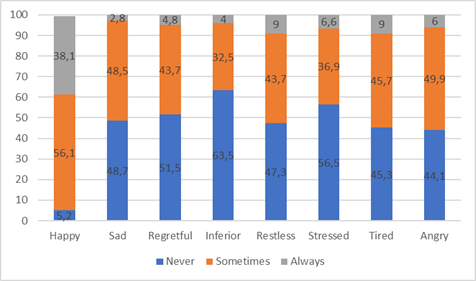
The respondents were required to reflect on the emotions they experienced after playing online games on a three point scale of never, sometimes and always. The emotions listed were being happy, sad, regretful, inferior, restless, stressed, tired and angry. Large proportions of the respondents had reported that they never experienced being inferior (63.47%), stressed (56.48%) and regretful (51.49%). The top three emotions that the respondents experienced sometimes were happy (56.69%), angry (49.9%) and sad (48.5%). More than 38.1% of the respondents reported that they always felt happy. The data has been presented as a percentage bar diagram (refer Diagram 2).
Diagram 2: Bar Diagram depicting the Emotions experienced after playing Online Games
3.6 Social Interactions during Online Gaming
Table 3: Respondents by Indicators of Socialisation
|
S.No |
Easier to make friends in online gaming platform and to experience good bonding with them |
Frequency (n) |
Percentage (%) |
|
1. |
Yes |
266 |
53.1% |
|
2. |
No |
235 |
46.9% |
|
|
Total |
501 |
100% |
|
S.No |
Easier to relate and converse with other friends |
Frequency (n) |
Percentage (%) |
|
1. |
Yes |
357 |
71.3% |
|
2. |
No |
144 |
28.7% |
|
|
Total |
501 |
100% |
|
S.No |
Social interaction |
Frequency (n) |
Percentage (%) |
|
1. |
Increased |
208 |
41.5% |
|
2. |
Decreased |
59 |
11.8% |
|
3. |
Same |
234 |
46.7% |
|
|
Total |
501 |
100% |
|
S.No |
Bullying / Exposed to Abuse in an Online Gaming Platform |
Frequency (n) |
Percentage (%) |
|
1. |
Yes |
84 |
16.8% |
|
2. |
No |
417 |
83.2% |
|
|
Total |
501 |
100% |
Socialisation in the context of online gaming was studied in terms of bonding with online friends, ease of making new friends, improved social interactions and instances of bullying / abuse (Table 3).
More than half of the respondents (53.1%) have affirmed that online gaming made it easier for them to make friends in online gaming platform and to experience good bonding with them. Majority of the respondents (71.3%) have reported that online gaming had made it easier for them to relate and converse with other friends. As regards change in social interaction after the online gaming experience, a little more than one-tenth of the respondents (11.8%) have stated that it has decreased. Almost one-fifth of the respondents (16.8%) have stated that they had experienced some form of bullying or abuse during their online gaming sessions.
Thus, while most respondents have reported positive indicators of socialisation, instances of decreased social interaction and abuse / bullying have also been reported.
Table 4: Respondents by symptoms faced after playing Online Games
|
S.No |
Symptoms Faced |
Frequency (n) |
Percentage (%) |
|
1. |
Blurred Vision |
125 |
17.05 |
|
2. |
Mild Headaches |
191 |
26.06 |
|
3. |
Disturbed Sleep |
167 |
22.78 |
|
4. |
Skipping meals |
63 |
8.59 |
|
5. |
None of the above |
187 |
25.51 |
|
|
Total |
733* |
100 |
* Multiple Responses
The symptoms faced due to online gaming were studied (Table 4). Results indicated that the top three physical ailments experienced were mild headaches (26.06%), disturbed sleep (22.7%) and blurred vision (17.05%). A little more than one-fourth of the respondents (25.51%) did not report any symptoms.
3.7 Extent of Online Gaming Disorder
The item-wise responses to the Internet Gaming Disorder Scale (Pontes & Griffiths, 2015) are listed in Table 5.
Table 5: Distribution of Respondents based on Gaming Disorder
|
S. No. |
Statements |
Never |
Rarely |
Sometimes |
Often |
Very Often |
Total |
|
1 |
Feeling preoccupied with your gaming behaviour. |
151 (30.1)* |
148 (29.5) |
156 (31.1) |
30 (6) |
16 (3.2) |
501 (100) |
|
2 |
Feeling more irritability, anxiety, or even sadness when you try to either reduce or stop your gaming activity. |
202 (40.3) |
119 (23.8) |
144 (28.7) |
22 (4.4) |
14 (2.8) |
501 (100) |
|
3 |
Feeling the need to spend increasing amount of time engaged gaming in order to achieve satisfaction or pleasure. |
226 (45.1) |
95 (19) |
134 (26.7) |
33 (6.6) |
13 (2.6) |
501 (100) |
|
4 |
Systematically failing when trying to control or cease your gaming activity. |
209 (41.7) |
127 (25.3) |
124 (24.8) |
29 (5.8) |
12 (2.4) |
501 (100) |
|
5 |
Lost interests in previous hobbies and other entertainment activities as a result of your engagement with the game. |
188 (37.5) |
99 (19.8) |
137 (27.3) |
50 (10) |
27 (5.4) |
501 (100) |
|
6 |
Continued your gaming activity despite knowing it was causing problems between you and other people. |
222 (44.3) |
99 (19.8) |
128 (25.5) |
36 (7.2) |
16 (3.2) |
501 (100) |
|
7 |
Deceived any of your family members, therapists or others because of the amount of your gaming activity. |
343 (68.5) |
60 (12) |
68 (13.6) |
18 (3.6) |
12 (2.4) |
501 (100) |
|
8 |
Played in order to temporarily escape or relieve a negative mood (Example: helplessness, guilt, anxiety). |
112 (22.4) |
78 (15.6) |
160 (31.9) |
102 (20.4) |
49 (9.8) |
501 (100) |
|
9 |
Jeopardized or lost an important relationship, job or an educational or career opportunity because of your gaming activity. |
346 (69.1) |
56 (11.2) |
70 (14) |
17 (3.4) |
12 (2.4) |
501 (100) |
*Figures in parentheses represent percentages
From Table 5 it is clear that almost one-third of the respondents (30.1%) did not feel preoccupied with the gaming disorder. However, 3.2% of the respondents have affirmed that they very often felt preoccupied with their gaming.
Similarly, 2.8% of the respondents have reported that they very often experienced irritability, anxiety, or even sadness when they tried to either reduce or stop their gaming activity.
Further, a few respondents (2.6%) have stated that they felt the need to spend increasing amount of time in gaming in order to achieve satisfaction or pleasure.
A little more than two-fifth (41.7%) of the respondents have opined that they never failed when trying to control or cease their online gaming activity.
A small proportion of the respondents (5.4%) have expressed that they very often have lost interests in previous hobbies and other entertainment activities as a result of their gaming activity.
A little more than one-fourth of the respondents (25.5%) have stated that they sometimes have continued their gaming activity despite knowing it was causing problems between them and other people.
Almost one-third of the respondents (31.5%) have reported that they have deceived at varying intensities any of their family members, therapists or others because of the amount of their gaming activity.
A little more than three-tenth of the respondents (30.2%) have stated that they frequently played in order to temporarily escape or relieve a negative mood like helplessness, guilt or anxiety.
Majority of the respondents (69.1%) have reported that they never have jeopardized or lost an important relationship, job or an educational or career opportunity because of their gaming activity.
3.8 Extent of Gaming Disorder
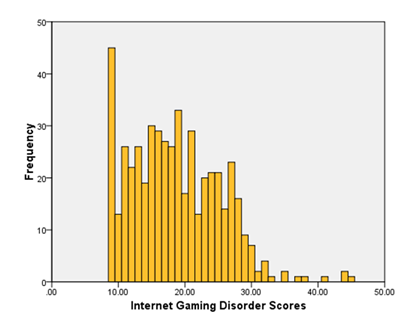
Gaming Disorder was measured using the Pontes & Griffiths Scale (2015) and as per the scoring pattern, a score of 32 or above indicates Gaming Disorder. Based on the scores it has been found that 2.6% of the respondents (n=13) have Gaming Disorder and 97.40 % of the respondents do not have Gaming Disorder. The mean score is 18.61 with a standard deviation of 6.68. The median score is 18. The minimum score obtained is 9 and the maximum score is 45. The histogram of the Gaming Disorder Scale scores is portrayed in Diagram 3.
Diagram 3: Histogram of the Gaming Disorder Scale scores
3.9 Socio-demographic profile and Gaming Disorder
To understand the interplay of socio-demographic factors and gaming disorder, appropriate tests of significance were applied.
Chi-square test was applied to test the association between age, education level and number of years of gaming and presence of internet gaming disorder. The test results are presented in Tables 6, 7 and 8.
Table 6: Testing of association between age group and presence of Internet Gaming Disorder
|
Age Group (in years) |
Presence of Internet Gaming Disorder |
Total |
Chi-square results |
|
|
Yes |
No |
|||
|
Up to 20 years |
6 (2.6%) |
229 (97.4%) |
235 (100.0%) |
Chi-square value = 0.003 df = 1 p value = .956 |
|
21 years & above |
7 (2.6%)
|
259 (97.4%) |
266 (100.0%) |
|
|
Total |
13 (2.6%) |
488 (97.4%) |
501 (100.0%) |
|
From Table 6, it is evident that there is no statistically significant association between age and the presence of internet gaming disorder.
Table 7: Testing of association between education level group and presence of Internet Gaming Disorder
|
Education Level |
Presence of Internet Gaming Disorder |
Total |
Chi-square results |
|
|
Yes |
No |
|||
|
Schooling |
5 (6.5%)
|
72 (93.5%) |
77 (100.0%) |
Chi-square value = 5.576 df = 2 p value = .062 |
|
Under Graduation |
6 2.1% |
286 97.9% |
292 100.0% |
|
|
Post Graduation |
2 1.5% |
130 98.5% |
132 100.0% |
|
|
Total |
13 (2.6%) |
488 (97.4%) |
501 (100.0%) |
|
From Table 7, it is evident that there is no statistically significant association between education level and the presence of internet gaming disorder.
Table 8: Testing of association between number of years of gaming and presence of Internet Gaming Disorder
|
Number of years of gaming |
Presence of Internet Gaming Disorder |
Total |
Chi-square results |
|
|
Yes |
No |
|||
|
Up to 2 years |
4 (1.8%) |
223 (98.2%) |
227 (100.0%) |
Chi-square value = 1.139 df = 1 p value = .286 |
|
2 years & above |
9 (3.3%) |
265 (96.7%) |
274 (100.0%) |
|
|
Total |
13 (2.6%) |
488 (97.4%) |
501 (100.0%) |
|
From Table 8, it is evident that there is no statistically significant association between number of years of gaming and the presence of internet gaming disorder.
Thus, the Chi-square test results indicated that there was no significant association between age, education and number of years of gaming and presence of internet gaming disorder.
Tests of significance of differences in the mean scores of internet gaming disorder on the basis of gender, employment status and number of games played were applied. The test results are presented in Tables 9, 10 and 11.
Table 9: Testing for differences in Internet Gaming Disorder scores based on gender
|
Gender |
N |
Mean |
Std. Deviation |
T value |
df |
p value |
|
Male |
289 |
19.6920 |
6.32280 |
4.277 |
499 |
0.000 |
|
Female |
212 |
17.1509 |
6.89225 |
From Table 9, it is clear that male respondents have a higher mean score of internet gaming disorder (19.6920) compared to the female respondents (17.1509). This difference is highly significant (t value = 4.277; p value = 0.000). Similar findings have been reported by Carras, et al. (2017).
Table 10: Testing for differences in Internet Gaming Disorder scores based on Employment Status
|
Employment Status |
N |
Mean |
Std. Deviation |
T value |
df |
p value |
|
Unemployed |
380 |
18.2474 |
6.21487 |
-2.201 |
499 |
0.028 |
|
Employed |
121 |
19.7769 |
7.89144 |
From Table 10 it is clear that employed respondents have a higher mean score of internet gaming disorder (19.7769) compared to the unemployed respondents (18.2474). This difference is significant at 0.05 level (t value = -2.201; p value = 0.028).
Table 11: Testing for differences in Internet Gaming Disorder scores based on number of games played
Table 11A: Summary of ANOVA results
|
|
Sum of Squares |
df |
Mean Square |
F |
Sig. |
|
Between Groups |
681.696 |
2 |
340.848 |
7.842 |
.000 |
|
Within Groups |
21644.723 |
498 |
43.463 |
||
|
Total |
22326.419 |
500 |
|
Table 11 B: Post-hoc test (Tukey’s HSD) results
|
(I) Number of Games played |
(J) Number of Games played |
Mean Difference (I-J) |
Std. Error |
Sig. |
95% Confidence Interval |
|
|
Lower Bound |
Upper Bound |
|||||
|
1-2 |
3-4 |
-2.06122 |
.88711 |
.054 |
-4.1466 |
.0241 |
|
More than 4 |
-4.03824* |
1.17736 |
.002 |
-6.8059 |
-1.2706 |
|
|
3-4 |
1-2 |
2.06122 |
.88711 |
.054 |
-.0241 |
4.1466 |
|
More than 4 |
-1.97702 |
1.39909 |
.335 |
-5.2659 |
1.3119 |
|
|
More than 4 |
1-2 |
4.03824* |
1.17736 |
.002 |
1.2706 |
6.8059 |
|
3-4 |
1.97702 |
1.39909 |
.335 |
-1.3119 |
5.2659 |
|
|
*. The mean difference is significant at the 0.05 level. |
||||||
From Table 11A it is clear that there is a significant difference in the mean scores of internet gaming disorder on the basis of number of games played (F value = 7.842, df = 498, p value = 0.000). Tukey’s Honestly Significant Difference (HSD) test reveals that the difference is significant for those who play 1-2 games and those who play more than 4 games with the latter group having higher mean scores of internet gaming disorder.
Thus, the tests of significance of differences in the mean scores of internet gaming disorder indicated that gender, employment status and number of games played were significant factors. Independent sample t-test results revealed that there was statistically significant difference in Internet Gaming Disorder scores on the basis of Gender and Employment Status. One way ANOVA results revealed that there was statistically significant difference in Internet Gaming Disorder scores on the basis of number of games played.
4 Discussion
Factors like digital revolution, access to internet data, ease of use of online games coupled with COVID-19 lockdown have contributed to the increase in online gaming. While this has opened new vistas of opportunities it has also thrown a host of challenges to the society at large. This survey on online gaming among Indian youth during COVID-19 lockdown has helped gain interesting insights into practices associated with online gaming. Respondents have been into online gaming even prior to the COVID-19 lockdown but have engaged in increased online gaming activity during COVID-19 lockdown.
Majority of the respondents have used mobile phones for online gaming. Globally, almost two-thirds of the internet traffic (62.5%) is attributed to mobiles (Buck, 2025). Mobile phones serve as the easiest gateway to explore online games as access to mobile phones is much easier compared to dedicated online gaming gadgets. Mobile phones are not only handy, but also provide private, cheaper and anytime, anywhere access. However, the prolonged use of mobile phones (with ear plugs / phones) is bound to affect eyesight and hearing (Stephenson, 2016).
Multiplayer Online Battle Arena games are preferred by most of the respondents. Such games are extremely involving owing to the visual, auditory and tactile experiences they provide resulting in higher incidences of prolonged play and increased frequency of play as well (Arbeau et al., 2020; Huang et al., 2024). Thus the engaging and captivating nature of the gaming elements pose a threat as they have the propensity to induce habit forming in online gaming.
For the respondents, the most appealing feature was the ability to socialize (for instance, to befriend or to compete) with fellow gamers in the online platforms. This opportunity to befriend fellow online gamers who may be ‘perfect strangers’ has the element of risk like cyber bullying. In fact almost one-fifth of the respondents have admitted that they have experienced bullying or abuse in online gaming platforms. This is a cause for concern. Yunhao et al. (2025) in their systematic literature review on cyber bullying in multiplayer online games have found that multiplayer online games provide a thriving ecosystem for cyber bullying owing to factors like gender, age, violent gaming, bi-directionality between victimisation and perpetration, normalisation and competition.
Most of the respondents have reported that they spent less than three hours per day on online gaming. Significant relation between gaming screen time and health outcomes like psychological problems, low self-concept, social problems, sleep problems and sleep time have been reported (Burén et al., 2023).
While engaging in online games, one not only expends time but also money. Inevitably, most respondents had made in-app purchases. In-app purchases are additional content or services within the app that the user could buy in some apps. Some of the examples of in-app purchases are, ‘a sword that gives you more power in a game’, ‘a key that unlocks more features of an app’, ‘virtual currency that can be used for purchases’ and so on. The experience of winning rewards or money on online games is also very addictive (John et al., 2020).
Almost one-tenth of the respondents have expressed that they very often engaged in online games to temporarily escape or relieve from a negative mood. Though the benefits of online gaming have been reported, their prolonged effects need to be studied.
Almost two-fifth of the respondents have stated that they felt pre-occupied with their gaming behaviour. For the study data, the mean score of internet gaming disorder is 18.61 with a standard deviation of 6.68. A similar score of internet gaming disorder (mean of 18.75 with standard deviation of 8.35) has been reported by Ajith et al. (2024) in their survey of internet gaming disorder among Indian youth (n=179) based out of Bangalore city.
The present study reveals that 2.6% of the respondents have internet gaming disorder. Stevens et al. (2020) in their meta-analysis of gaming disorder (as reported by 53 studies worldwide) found that the prevalence of gaming disorder was 3.05% (with a confidence interval of 2.38 to 3.91. The study data prevalence of internet gaming disorder falls with the worldwide prevalence rate and is a cause for concern.
Inferential statistics revealed that there was no significant association between age, education and number of years of gaming and presence of internet gaming disorder. However, statistically significant differences in the mean scores of internet gaming disorder could be attributed to gender, employment status and number of games played. Male respondents and those who were employed and those who played most number of games had higher signs of problematic gaming.
At the regulatory front, in the Indian context, online gaming involving real money has been recognized by the Government as a social concern owing to the “unsustainable debt resulting in suicides” and its impact on families. For instance, the Tamil Nadu State Government passed the Tamil Nadu Prohibition of Online Gambling and Regulation of Online Games Act, 2022 which banned online rummy and online poker. However, this Act was challenged and in response, the Tamil Nadu Online Gaming Authority (Real Money Games) Regulations, 2025 has been introduced that has laid regulations for online games involving real money. Similarly, the Central Government has enacted the Promotion and Regulation of Online Gaming Act, 2025 also directed at real money games.
However, in the context of online gaming not involving real money, while benefits and ill-effects have been reported, their long-term impact is yet to be ascertained. Hence, individual discretion is required to protect against the hazards of online gaming.
5 Implications for social work practice
Online gaming as a concept and as a practice offer significant insights for contemporary social work practice. The benefits of online gaming have been widely documented. This could be harnessed through gamification that is bringing in game based elements in non-game based settings. The therapeutic value of online gaming can be explored and appropriately adopted. The social and co-operative aspects of gaming such as communication, team work, strategic thinking can be utilized to cultivate positive skills such as empathy and leadership. When incorporated appropriately in the therapeutic and educational interventions, gamified learning and online peer-support models can serve as a means of improving teenage engagement and resilience (Park et al., 2022). Successful attempts to tap the educational potential of multiplayer games for the benefit of autistic children have been reported (Santhanam, 2023; Stonea et al., 2025). Perepezko et al. (2024) have reported about the usability and efficacy of an online gaming community in providing mental health support to its users who were US military veterans. The Stack Up Overwatch Program (StOP) intervention had trained and supervised volunteers who provided mental health support to the gamers. Results indicated that the StOP intervention helped reduce the veterans’ anxiety and improved their coping skills. The initiative was found useful by the gamers and the gamer-volunteers. The former opined that the intervention fulfilled their need for support and connection when other venues were inaccessible or inadequate; the latter opined that it gave a “family feeling” of being available to those in need of mental health support.
On the other hand, the hazards of online gaming are imminent. The inclusion of gaming disorder in ICD-11 and DSM-5 reiterate the same. Youth and adolescents are more prone to gaming disorder (Smahel et al, 2008). At the macro level, this calls for regulation. In this regard, social workers and other mental health professionals in collaboration with the policymakers, educators and digital regulators can ensure that the appropriate legislations and policies are in place.
At the micro level, social workers have a role to play in prevention, early intervention, and rehabilitation. Social workers and counsellors who are working with youth populations can use screening tools to assess digital behaviours. Psychoeducation programs targeting healthy online engagement and family discussions regarding screen-use limits can be provided to address the problematic use of online gaming. Digital literacy curriculum and family-based prevention programs of UK and South Korea that facilitate balanced digital engagement (Park et al., 2022) can be explored in the Indian context. To address cyber bullying, abuse and victimization instances, working with cyber security organizations to offer resources to victims of online bullying or exploitation could be facilitated.
At the meso level, to address the negative effects of online gaming, sensitization events about the ill-effects of online gaming and workshops on time management and emotional regulation can be carried out. Parents with young children should be strongly advised not to accustom the children to mobile games as a distraction mechanism. Dedicated help lines may be created to help those experiencing the detrimental effects of online gaming like abuse, financial losses, depression or other forms of cyber attacks. To equip the social work students, the social work curriculum should also provide inputs on technology-mediated therapies and aspects of digital social work and cyberpsychology.
In the context of educative therapeutic applications of online games, it would be beneficial to draw from the experiences of serious games – “games that do not have entertainment, enjoyment or fun as their primary purpose” (Michael & Chen, 2005). However, in the field of social work, the use of serious games is infrequent (Mäkinen et al., 2023). From the regulatory front, gaming companies as a social responsibility could be impressed upon to imbibe the thrust of serious games and invest in serious games for suitable social work applications.
There is only a thin line between online gaming and online gambling. Mohan (2025) based on her longitudinal study of three groups of online gamers (aged 9, 17 and 20 years respectively) and their propensity to engage in online gambling found that individuals who engaged in online gaming at age 17 were 1.4 times more likely to gamble at age 20 years while those engaged in online gaming at age 20 years were 1.7 time more likely to engage in online gambling. However, no association was found among those aged 9 years. She calls for further research given the onslaught of loot box games and social casino games. Such insights serve as a clarion call for social work professionals as well.
Further, the monetisation of e-sports across the world (in the form of tournaments with prize money) are concerns. Such sporting banners are bound to arouse further interest and provide a fillip to the phenomenon prompting recreational gamers to become competitive gamers. This calls for the presence of social workers in the e-sports team to carry out routine mental health assessments and monitor the same.
The research potential of the issue is immense. Social workers could conduct longitudinal studies to map the impact of the benefits and ill-effects of online gaming on a sustained manner. Similarly, experimental studies to test the effectiveness of statutory warnings before the start of each gaming session or compulsory breaks for each gaming routine or mandatory digital detox sessions could be carried out. These initiatives could provide local evidence for a global problem.
6 Conclusion
This study has helped gain interesting insights into online gaming among young adults in terms of online gaming experiences, resources committed, monetary implications of online gaming, emotional experiences of online gaming and online gaming disorder. The growing online gaming behaviour and the imminent scope for it to emerge as a disorder are causes for concern to self, immediate others and society at large. This offers ample scope for social work practice and is of interest to social work educators and practitioners alike.
References:
Ajith, S.J., Narayanan, G., Sharma, M. K., Anand, N., Vishwakarma, A. (2024). Online gaming motives, family relationships, and personality among Indian youth. Indian Psychiatry Journal, 33(1):81-87. doi: 10.4103/ipj.ipj_123_23.
American Psychiatric Association. (2018). Internet Gaming in DSM-5. https://www.psychiatry.org/patients-families/internet-gaming.
Arbeau K., Thorpe C., Stinson M., Budlong B., Wolff J. (2020). The meaning of the experience of being an online video game player. Computers in Human Behavior Reports. 2:100013. doi: 10.1016/j.chbr.2020.100013.
Archana R., Sharma, M., Kumar, K., & Marimuthu, P. (2019). Internet gaming disorder and psychiatric symptoms in Bengaluru, India: Treatment implication for promotion of user mental health. Indian Journal of Social Psychiatry, 35(2), 135-136. https://doi.org/10.4103/ijsp.ijsp_42_18.
Balhara, Y. S., Kattula, D., Singh, S., Chukkali, S., & Bhargava, R. (2020). Impact of lockdown following COVID-19 on the gaming behavior of college students. Indian Journal of Public Health, 64(6), 172. https://doi.org/10.4103/ijph.ijph_465_20.
Barr, M., & Copeland-Stewart, A. (2021). Playing Video Games during the COVID-19 Pandemic and Effects on Players’ Well-Being. Games and Culture, 17(1), 122-139. https://doi.org/10.1177/15554120211017036.
Bora, G. (2020 April 13). For Indian gaming startups, Covid-19 lockdown is a boon for business. The Economic Times. https://economictimes.indiatimes.com/small-biz/startups/newsbuzz/for-indian-gaming-startups-covid-19-lockdown-is-a-boon-for-business/articleshow/75115595.
Buck (2025, July 3). What Percentage of Internet Traffic is Mobile? https://www.mobiloud.com/blog/what-percentage-of-internet-traffic-is-mobile.
Burén,J., Nutley,S.B., Thorell,L.B. (2023). Screen time and addictive use of gaming and social media in relation to health outcomes. Frontiers in Psychology, 14, 1258784. https://doi: 10.3389/fpsyg.2023.
Carras, M.C., Rooij, A.J.V., de Mheen, D.K., Musci, R., Xue, Q., & Mendelson, T. (2017). Video gaming in a hyperconnected world: A cross-sectional study of heavy gaming, problematic gaming symptoms, and online socializing in adolescents. Computers in Human Behavior, 68. https://doi.org/10.1016/j.chb.2016.11.060.
Crime among city youths due to online gaming a concern: Cops. (2021 March 28). The Times of India. https://timesofindia.indiatimes.com/city/jaipur/crime-among-city-youths-due-to-online-gaming-a-concern-cops/articleshow/81728208.cms.
Davies, P. (2020 November 11). What Are The Different Types Of Online Games? Player. https://play3r.net/news/what-are-the-different-types-of-online-games/.
Dekker, S., & Slotboom, C. (2023). Benefits of recreational gaming. International Journal of Esports, I(1). https://www.ijesports.org/ijesports/public/article/96/html.
ECI games. (2025). Where in The World are The Gamers? https://www.ecigames.net/media/where-in-the-world-are-the-gamers-a-study-of-gaming-populations-emerging-markets.
Government of India. (2022). Youth in India 2022 I Ministry of Statistics & Programme Implementation I Government of India. https://mospi.gov.in/sites/default/files/publication_reports/Youth_in_India_2022.pdf.
How online gaming has become a social lifeline. (2020 December 16). BBC. https://www.bbc.com/worklife/article/20201215-how-online-gaming-has-become-a-social-lifeline.
Huang E, Xing Y, Song X. (2024). Emotional analysis of multiplayer online battle arena games addiction. Frontiers in Psychology, 15, 1347949. https://doi: 10.3389/fpsyg.2024.
Javed, J. (2020 March 29). eSports and gaming industry thriving as video games provide escape from reality during coronavirus pandemic. WFAA.com. https://www.wfaa.com/article/sports/esports-gaming-industry-thriving-as-video-games-provide-escape-from-reality-during-coronavirus-pandemic/287-5953d982-d240-4e2b- a2ba-94dd60a8a383.
John, N., Sharma, M.K., Anand, N., Gandhi, S., Thakur, P.C., Sahu, M., Mondal, I., Singh, P., Suma, N., Tadpatrikar, A., Ahuja, S., Ajith, S.J., Murthy, K.D., Gupta, H.K. (2020). Pathways of migration from gaming to gambling. Industrial Psychiatry Journal, 29(1), 159. https://doi.org/10.4103/ipj.ipj_45_20.
Kalaari Capital. (2023). Gameconomy Report 2023. https://kalaari.com/wp-content/uploads/2023/01/Gameconomy-by-Kalaari-Jan-2023.pdf.
KPMG. (2017). Online gaming in India: Reaching a new pinnacle. https://assets.kpmg/content/dam/kpmg/in/pdf/2017/05/online-gaming.
Lumikai Investment Advisors. (2023). Leveling up: State of India Gaming FY’23. https://investgame.net/wp-content/uploads/2024/11/Lumikai-Gaming-Report-2023_Exec-Summary.pdf.
Mäkinen, H., Kauhanen, E., Nykänen, K., Romppanen, T., & Koivisto, J.-M. (2023). Preventing adolescents’ social exclusion with serious games – a scoping review. International Social Work, 67(4), 922-938. https://doi.org/10.1177/00208728231178399.
Michael, D. R., & Chen, S. L. (2005). Serious games: Games that educate, train, and inform. Muska & Lipman/Premier-Trade.
Misra, R., Singh, S., & Singh, N. (2020). Assessing Behavioral Patterns for Online Gaming Addiction: A Study among Indian Youth. International Journal of Cyber Behavior, Psychology and Learning, 10(2), 43-64. https://doi.org/10.4018/IJCBPL.2020040104.
Mohan, G. (2025). Kid gamers to adult gamblers? An investigation of gaming in childhood and young adult gambling. International Gambling Studies, 25(2), 347–365. https://doi.org/10.1080/14459795.2025.2488867.
Naskar, S., Victor, R., Nath, K., & Sengupta, C. (2016). “One level more:” A narrative review on internet gaming disorder. Industrial Psychiatry Journal, 25(2), 145-154. https://doi.org/10.4103/ipj.ipj_67_16.
Online games seen picking momentum since COVID-19 outbreak. (2021 June 14). The Hindu. https://www.thehindu.com/business/online-games-seen-picking-momentum-since-covid-19-outbreak/article34815636.ece.
Park, J.J., King, D.L, Wilkinson-Meyers, L., Rodda. S.N. (2022). Content and Effectiveness of Web-Based Treatments for Online Behavioral Addictions: Systematic Review. JMIR Mental Health. 9(9), e36662. https://doi: 10.2196/36662.
Perepezko, K., Bergendahl, M., Kunz, C., Labrique, A., Carras, M., & Colder Carras, M. (2024). “Instead, You’re Going to a Friend”: Evaluation of a Community-Developed, Peer-Delivered Online Crisis Prevention Intervention. Psychiatric Services, 75(12), 1267–1275. https://doi.org/10.1176/appi.ps.20230233.
Pontes, H.M., & Griffiths, M.D. (2015). Measuring DSM-5 internet gaming disorder: Development and validation of a short psychometric scale. Computers in Human Behavior, 45, 137-143. https://doi.org/10.1016/j.chb.2014.12.006.
Santhanam, S. (2023) An interactive and neurodiversity-affirming approach to communication supports for autistic students through Videogaming. Language, Speech, and Hearing Services in Schools, 54(1), 120–139. https://doi.org/10.1044/2022_LSHSS-22-00027.
Smahel D, Blinka L, Ledabyl O. (2008). Playing MMORPGs: connections between addiction and identifying with a character. CyberPsychology & Behaviour, 11(6):715-8. https://doi.org/10.1089/cpb.2007.0210.
Statista. (2021). Online gaming – statistics & facts. https://www.statista.com/topics/1551/online-gaming/#dossierKeyfigures.
Stephenson, S. (2016 September 21). Could hearing loss be a hidden cost of gaming? TIGA. https://tiga.org/news/could-hearing-loss-be-a-hidden-cost-of-gaming.
Stevens, M.W., Dorstyn, D., Delfabbro, P.H., King, D.L. (2020). Global prevalence of gaming disorder: A systematic review and meta-analysis. Australian & New Zealand Journal of Psychiatry, 55(6):553-568. doi:10.1177/0004867420962851.
Stonea, B.G., Millsb, K.A., Saggersc, B., Blundelld, C. & Friende, L. (2025) Multiplayer gaming and autism: Social communication through repetitive behaviours. Journal of Research in Special Educational Needs, 25, 752–765. https://doi.org/10.1111/1471-3802.70007.
World Health Organization. (2018, September, 2018). Inclusion of “gaming disorder” in ICD-11. https://www.who.int/news/item/14-09-2018-inclusion-of-gaming-disorder-in-icd-11.
Yadav, V.K. (2022, February 17). 14-year-old boy dies by suicide, cops suspect gaming addiction. Hindustan Times. https://www.hindustantimes.com/cities/mumbai news/14yearold-boy-dies-by-suicide-cops-suspect-gaming-addiction-101645077923161.html.
Yunhao, H., Sophie, E., Elizabeth M.C., & Bianca, K. (2025). Player versus Player: A systematic review of cyberbullying in multiplayer online games. Computers in Human Behavior Reports, 18, 100675. https://doi.org/10.1016/j.chbr.2025.100675.
Author´s
Address:
Dr. J. S. Gunavathy
Associate Professor
Department of Social Work (Aided Stream)
Madras School of Social Work, Chennai, India
jsgunavathy@gmail.com
jsgunavathy@mssw.in
Author´s
Address:
R. Shama Shareen
MSW Student of 2020-22 Batch
Department of Social Work (Aided Stream)
Madras School of Social Work, Chennai, India
shamashareen06nov@gmail.com
Author´s
Address:
N. T. Bhanu Priya
MSW Student of 2020-22 Batch
Department of Social Work (Aided Stream)
Madras School of Social Work, Chennai, India
bhanumswa20@mssw.in
Author´s
Address:
S. Harisha
MSW Student of 2020-22 Batch
Department of Social Work (Aided Stream)
Madras School of Social Work, Chennai, India
harishas211@gmail.com
Author´s
Address:
L. Jenita Evangeline
MSW Student of 2020-22 Batch
Department of Social Work (Aided Stream)
Madras School of Social Work, Chennai, India
jenitamswa20@mssw.in
Author´s
Address:
E. M. Prem Jonathan
MSW Student of 2020-22 Batch
Department of Social Work (Aided Stream)
Madras School of Social Work, Chennai, India
premjonathanem@gmail.com
Author´s
Address:
J. Priyadarshini
MSW Student of 2020-22 Batch
Department of Social Work (Aided Stream)
Madras School of Social Work, Chennai, India
priya.priya.dharshini215@gmail.com